


What Is Piano Regulation & Does Your Piano Need It?
A piano can be perfectly in tune and still feel difficult, uneven, or unresponsive. Some keys may feel heavier than others, certain notes may not repeat properly, or the instrument may be difficult to play quietly and expressively.
When these problems appear, the piano may not need another tuning. It may need piano regulation.
Piano regulation is the process of adjusting the mechanical parts inside a piano so that the keyboard and action respond consistently. It can improve the instrument’s touch, control, repetition, and overall playability.
Understanding what piano regulation involves can help you determine whether your piano needs professional attention and what type of service may restore its performance.
What Is Piano Regulation?
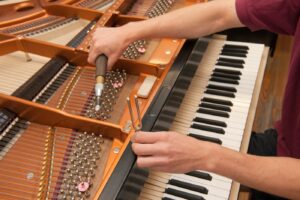
Professional piano regulation involves making precise adjustments to the piano’s action, which is the mechanical system that transfers movement from the keys to the hammers.
When you press a key, a series of small wooden, felt, metal, and leather components work together to move the hammer toward the strings. After the note sounds, the hammer must return to the correct position so the key can be played again.
Each key contains numerous action parts that must operate within very small tolerances. Across all 88 keys, even slight differences can create noticeable inconsistencies in touch and response.
During regulation, a piano technician adjusts these components so that the keys, hammers, dampers, and pedals work together as evenly as possible.
Regulation does not usually involve replacing the entire piano action. Instead, it focuses on correcting the position, movement, and timing of its individual parts.
Piano Regulation vs Piano Tuning
Piano regulation and piano tuning address two different aspects of the instrument.
Piano tuning adjusts the tension of the strings so that the notes produce the correct pitch. It focuses primarily on how the piano sounds.
Piano regulation adjusts the mechanical action so that the piano responds properly when played. It focuses primarily on how the piano feels and performs.
A piano may need tuning if:
- Notes sound sharp, flat, or out of tune
- Chords sound unpleasant or unstable
- The instrument has not been tuned for an extended period
- The piano has been exposed to seasonal temperature or humidity changes
A piano may need regulation if:
- Some keys feel heavier or lighter than others
- Notes respond unevenly
- Keys repeat slowly
- Soft playing is difficult to control
- The keyboard feels sluggish or inconsistent
Many pianos benefit from both services. Tuning helps the instrument produce the correct pitch, while regulation helps the pianist control that sound more accurately.
What Does Piano Regulation Include?
The exact regulation process depends on the type, age, condition, and design of the piano. Upright and grand pianos use different action systems, although both require careful adjustment.
A technician may inspect and adjust several areas of the instrument.
Key Height and Key Dip
Key height refers to how evenly the keys sit across the keyboard. Key dip describes how far a key travels downward when pressed.
If these measurements are inconsistent, some keys may feel deeper, shallower, heavier, or less responsive than others.
Adjusting key height and dip can help create a more uniform playing experience across the entire keyboard.
Hammer Movement
The hammers must travel the correct distance and strike the strings at the proper point. If their position or movement is uneven, notes may respond differently even when played with the same amount of force.
Regulation can help ensure that the hammers move consistently and return to the correct resting position.
Repetition and Escapement
A well-regulated piano should allow notes to repeat quickly and reliably.
Escapement is the point at which the hammer is released just before it reaches the string. This allows the hammer to strike the string and rebound rather than remaining pressed against it.
If the escapement or repetition mechanism is not properly adjusted, fast passages, repeated notes, and delicate playing may become more difficult.
Dampers
Dampers stop the strings from vibrating after the keys are released. If they do not lift and return evenly, some notes may continue ringing longer than expected or stop too quickly.
Proper damper regulation helps the pianist control note duration and sustain more accurately.
Pedals
The pedals are connected to mechanical systems inside the piano. If the pedal mechanisms are loose, noisy, or improperly adjusted, they may not respond consistently.
Regulation may include adjustments to improve pedal movement, timing, and control.
Signs Your Piano May Need Regulation
Changes in piano action often occur gradually. Because the pianist adapts to the instrument over time, regulation problems may not be immediately obvious.
There are several common signs that your piano may need to be inspected.
The Keyboard Feels Uneven
Some keys may feel heavier, lighter, deeper, or shallower than others. This unevenness can make scales, chords, and fast passages more difficult to play consistently.
Notes Do Not Repeat Properly
A regulated piano should allow notes to repeat smoothly. If a key must return almost completely before it can be played again, the action may require adjustment.
This problem is often especially noticeable during trills, repeated chords, and technically demanding passages.
Soft Playing Is Difficult
Playing quietly requires precise control over the keys and hammers. If the action is uneven, certain notes may sound too loudly, fail to sound, or respond unpredictably at low volume.
A properly regulated piano gives the player greater control over soft dynamics and subtle expression.
Keys Feel Sluggish
Keys that return slowly or feel resistant may indicate friction, worn materials, humidity-related movement, or improper action adjustment.
A sluggish keyboard can make the piano feel tiring and unresponsive.
The Piano Sounds Uneven Even When Played Consistently
If some notes sound noticeably louder or softer than neighboring notes, the problem may involve regulation, voicing, or both.
Regulation affects how the hammers move, while voicing affects the tonal character of the hammers. A technician can determine which service is needed.
The Piano Has Been Played Heavily
Pianos used by teachers, schools, churches, studios, performance venues, and serious musicians may experience action wear more quickly than instruments played occasionally at home.
Frequent use can compress felt, loosen components, and gradually change important action measurements.
Why Does a Piano Go Out of Regulation?
A piano’s action contains many natural materials, including wood, felt, and leather. These materials change over time as the instrument is played and exposed to its environment.
Felt can compress. Wood can expand or contract. Leather parts can wear. Screws and action components may gradually shift.
Temperature and humidity changes can also affect the piano’s mechanical parts. Wood may swell during humid conditions and shrink when the air becomes dry. These changes can alter key movement, alignment, and friction.
Normal playing also contributes to gradual changes. Every time a key is pressed, the action components move and make contact with one another. Over many years, this can affect the instrument’s responsiveness.
Needing regulation does not necessarily mean that a piano has been poorly maintained. It is often a normal part of caring for an acoustic piano.
How Often Does a Piano Need Regulation?
There is no single regulation schedule that applies to every piano.
The appropriate interval depends on:
- How frequently the piano is played
- The skill and sensitivity of the pianist
- The quality and condition of the action
- The stability of the room’s temperature and humidity
- The age of the instrument
- The amount of previous maintenance
A lightly used home piano may go many years before requiring substantial regulation. A heavily played professional, teaching, or institutional piano may need attention more often.
The best approach is to have the action evaluated during regular piano service. A technician can identify developing problems before they significantly affect performance.
Do New Pianos Need Regulation?
A new piano may still benefit from regulation.
During shipping, delivery, and adjustment to a new environment, action components can shift slightly. Felt and other materials may also settle during the piano’s early period of use.
Many quality pianos receive preparation and regulation before being placed on a showroom floor or delivered to a customer. However, the amount of preparation can vary.
After a new piano has been played for some time, additional regulation may help refine its touch and response.
This does not necessarily indicate a defect. It can be part of properly preparing and maintaining a mechanical instrument.
Do Used Pianos Need Regulation?
Used pianos are often strong candidates for regulation, especially when their maintenance history is unknown.
A pre-owned piano may have been played heavily, stored in unstable conditions, moved several times, or left without professional service for an extended period.
Before purchasing a used piano, it is helpful to have the instrument professionally evaluated. The piano may require only tuning and minor adjustments, or it may need more extensive regulation, repairs, or action restoration.
Regulation can significantly improve a good-quality used piano, but it cannot correct every structural or mechanical problem. A professional inspection can help determine whether the instrument is a suitable candidate for the work.
Can Regulation Improve an Older Piano?
Regulation can improve many older pianos, but the condition of the action must be considered.
When the components are still structurally sound, adjustment may restore much of the piano’s responsiveness and consistency. However, regulation alone may not be enough if parts are severely worn, broken, hardened, or deteriorated.
An older piano may need:
- Minor action adjustments
- Replacement of worn action parts
- Key repairs
- Hammer reshaping or replacement
- Damper work
- Action rebuilding
- More extensive piano restoration
A technician can determine whether regulation is appropriate or whether repairs should be completed first.
What Are the Benefits of Piano Regulation?
The most noticeable benefit of regulation is a more consistent keyboard.
When the action is properly adjusted, the pianist may experience:
- More even key resistance
- Faster and more reliable repetition
- Better control at soft volumes
- Greater dynamic range
- Improved responsiveness
- More predictable pedal operation
- Less fatigue during extended playing
- A stronger connection between touch and sound
For beginners, a consistent action can make it easier to develop proper technique. For advanced pianists, regulation can provide the precision needed for detailed phrasing, rapid repetition, and expressive control.
Regulation does not change the pianist’s ability, but it can remove mechanical inconsistencies that interfere with playing.
Is Piano Regulation Worth It?
Piano regulation can be worthwhile when the instrument is of reasonable quality and its overall condition justifies the service.
A piano that feels uneven or unresponsive may not need to be replaced. Professional regulation may restore much of its playability and make it more enjoyable to practice and perform.
The value of regulation depends on the piano, the extent of the required work, and the owner’s expectations. A full evaluation is important because similar symptoms can be caused by worn parts, moisture problems, damage, or other mechanical issues.
Rather than assuming the piano needs a major restoration, a replacement, or another tuning, have the action inspected by an experienced technician.
Have Your Piano Professionally Evaluated
Piano regulation is a detailed process that requires training, specialized tools, and a strong understanding of piano action geometry. Small adjustments can affect several other parts of the mechanism, so regulation should be completed as a coordinated process rather than a series of isolated changes.
Roger’s Piano can evaluate your instrument and help determine whether it needs tuning, regulation, repairs, or a combination of services.
A properly regulated piano should feel consistent, responsive, and comfortable throughout the keyboard. Whether you own an upright piano, baby grand, or full-size grand piano, professional regulation can help the instrument perform closer to its potential and give you greater control over every note.


